 John
JohnOpening Moments, Lasting Impact
Here’s a simple truth: the first minute at your front counter can set the tone for the whole visit. Reception Desks stand between a guest’s intent and their experience, like a gate that opens or sticks. Picture a morning rush: ten people queue, two staff scramble, and one screen freezes—again. In retail and fitness, that first minute often decides whether a guest stays, buys, or bounces. Studies show that each extra minute in line raises abandonment risk, and the cost of a lost visit is not small, nha. So the question is plain: how do we speed up the welcome without losing the warmth?

We’ll examine what we glossed over earlier: where friction hides inside the furniture, the workflow, and even the cables. We’ll also compare settings with different needs, because context matters. The path forward is not about buying bigger counters. It’s about smarter flow, safer data, and clear roles—plus a few practical fixes that stick. Let’s move to the root causes and see what we can fix today.
Part 2 — The Hidden Frictions at the Gym Counter
Where do queues really start?
In Part 1, we mapped the rush-hour bottlenecks. This time, let’s get technical and direct. A gym reception desk is more than a top and a smile; it is a small system. Think about access control, the POS terminal, and ID capture running in one tight zone. When these steps overlap, a 20-second task becomes a 2-minute wait—funny how that works, right? Poor cable management slows device swaps. A clogged barcode lane makes members hold their bags longer. And if the counter height ignores ADA compliance, staff bend or twist, which reduces speed across a whole shift. Small details stack up.
Traditional fixes say “add one more staff” or “buy a faster scanner.” Look, it’s simpler than you think. Re-sequence the check-in flow so entry verification happens before payment. Put an RFID reader at the edge so guests tap while they queue. Use a compact power converters strip under the front lip to cut reach time for chargers. Add one edge computing node to cache membership data during Wi‑Fi hiccups. These upgrades are not flashy, but they reduce motion, clicks, and handoffs. Less motion means less time. Less time means fewer apologies at the door.
Part 3 — Looking Ahead: Smarter Desks by Design
What’s Next
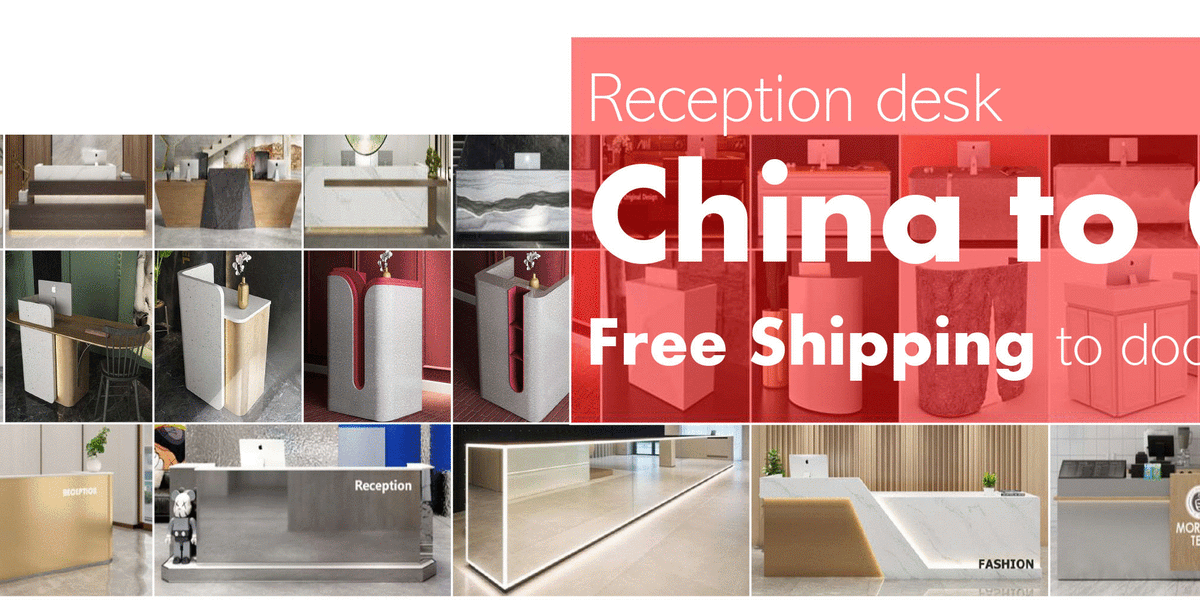
Now, shift the lens. Gyms and salons share a greeting ritual but run on different rhythms. A salon reception desk handles bookings, upsells, and stylist timing, while a gym desk pushes fast throughput and repeat check-ins. The next wave uses new technology principles, not just prettier counters. Modular panels route power and data on separate tracks for cleaner thermal management. Low-latency scanners pair with a local cache, so ID checks keep moving if the cloud stalls. IoT sensors count queue length and suggest lane changes—like traffic, but human scale. The desk starts to act as a small hub, or even a rules engine, not only furniture.
Here’s the comparative payoff. In gyms, a staged lane with pre-tap verification and a visible status light shortens dwell by 25–40 seconds. In salons, a split surface—consult zone plus payment zone—reduces booking errors and cross-talk. Both win when we treat the counter as a workflow device. We keep the human welcome, yes, but we trim the friction. And we do it with simple swaps: better cable channels, a smart LED driver for cues, and a tight handoff between devices and staff roles. It feels modern without feeling cold—and that balance is key (đúng không?).
To choose the right path, consider three metrics. One: time-to-serve from first hello to handoff; measure the median and the 90th percentile. Two: error rate across ID, booking, or payment steps; track retries and voids. Three: adaptability score—how fast can you reconfigure lanes, devices, or signage for a new promo or a rush hour? If these numbers move in the right direction, your desk design is working, no need for guesswork. For deeper benchmarks and layout ideas, see resources from M2-Retail.

 SEO
SEO admin
admin